8 Best eSIM for Africa 2026 | Safari to City Signal


MTN alone covers 17 African nations and serves more than 290 million subscribers, yet your home carrier still charges $25 per day to roam on it. Land at Jomo Kenyatta International in Nairobi and the billing starts the moment the wheels touch tarmac.
Head into Masai Mara without a local data plan and you are navigating offline through predator country with no lodge contact and no maps.
An eSIM for Africa cuts that off entirely. Install a regional plan before departure, arrive in Nairobi, Cape Town, or Lagos, and connect to Safaricom, MTN, or Vodacom before you reach baggage claim. I have tested plans across Kenya, South Africa, and Tanzania.
The gap between a strong Africa eSIM and a weak one shows up in your signal bars inside a game reserve, not in the marketing copy.
These are the 8 worth your attention in 2026.
Why Network Backbone Depth Separates a Good eSIM for Africa from a Dead Zone
An eSIM for Africa is a digital SIM profile installed on any unlocked eSIM-capable device via QR code scan. No physical card. No airport kiosk. The profile connects automatically to whichever carrier your provider has negotiated access with in each country.
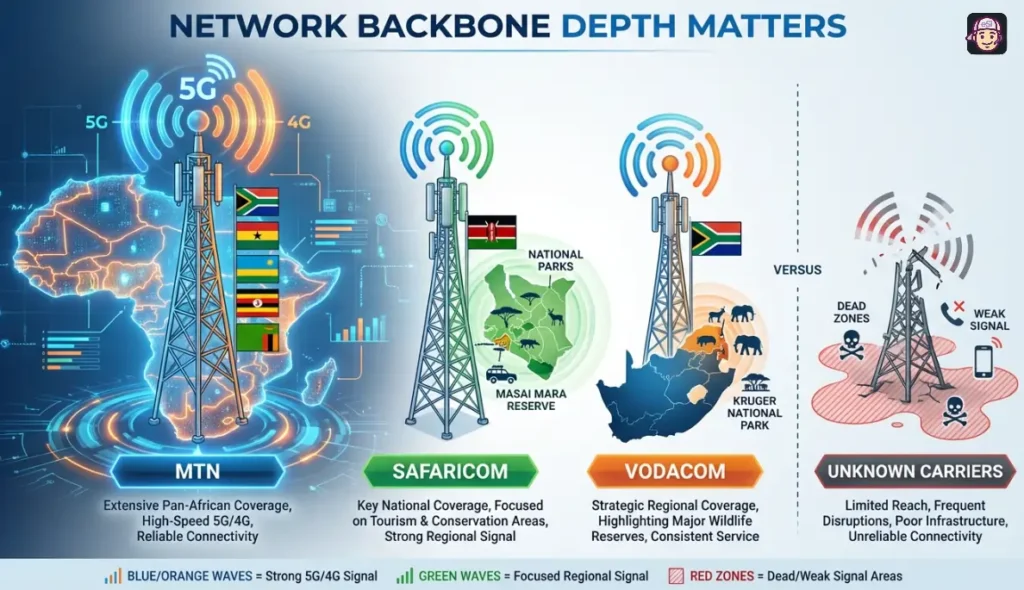
The make-or-break factor on the continent is naming that carrier. MTN operates the widest African footprint, with 5G active in South Africa and 4G spread across Nigeria, Ghana, Rwanda, Uganda, and Zambia.
Safaricom is the only network that delivers reliable LTE inside Kenya's national parks and rural corridors, including the Masai Mara circuit.
Vodacom leads in South Africa's eastern regions, covering the Kruger Park approach roads better than any alternative. Providers that name these carriers in their plan documentation are worth trusting. Providers that list “major local carriers” are telling you they do not actually know.
For trips spanning multiple African countries, a regional Africa plan outperforms manually stacking country-specific eSIMs at each border. One profile. One activation. Silent network switching between MTN South Africa and Safaricom Kenya.
For an eSIM for Africa, always confirm the specific carrier partner for your destination country. A plan that routes through MTN in South Africa but relies on a weaker partner in Kenya will disappoint the moment you leave a major city for a safari lodge or a game drive.
8 Best eSIM for Africa 2026 Ranked by MTN and Safaricom Signal Access
| Africa eSIM Provider | Africa Strength | Ideal Traveller |
|---|---|---|
| GigSky | MTN and Vodacom 5G access | Safari business flyer |
| Saily | Single eSIM 200-plus countries | Cape Town digital nomad |
| Airalo | Regional plan 29-plus countries | First-time safari visitor |
| Amigo eSIM | Sub-Saharan auto-switching | East Africa backpacker |
| MobiMatter | Aggregated plan marketplace | Value-hunting explorer |
| Maya | Auto top-up monthly renewal | Volunteer or NGO worker |
| iRoamly | Daily flexibility for port stops | Cruise and coastal traveller |
| Instabridge | Long-validity plus Wi-Fi layer | Extended Nairobi stay |
1. GigSky
Gigsky partners directly with MTN, Vodacom, and Cell C in South Africa, which places it above most MVNO resellers for the continent's busiest tourist destination.
The Africa regional plan covers 30-plus countries, with 5G access on the MTN backbone in Johannesburg, Cape Town, and Durban. South Africa alone has 17 plan configurations, from a 1-day Joburg business stop to a 30-day Kruger overland.
The enterprise-grade infrastructure behind the product shows up in routing stability at Cape Town's co-working corridors and Sandton's financial district.
👉Get GigSky for Africa
Key Features:
Pros:
Cons:
Why Gigsky for Africa: Direct carrier-level access to MTN and Vodacom in South Africa means your signal comes from the source rather than a resale layer. For the Kruger-to-Cape-Town corridor, that difference is noticeable on long stretches of the N2 and R71.
2. Saily
Saily covers 200-plus countries on a single reusable eSIM profile, which is the real advantage for Africa travellers crossing from South Africa into Kenya, then onwards into Rwanda or Tanzania.
You install once. No reinstallation at customs. The built-in Nord Security ad blocker cuts data consumption quietly on every travel booking page and news feed, which adds up across a three-week overland route.
Plans start at $7.99, tethering is unlimited on every tier, and 24/7 live chat has consistently been one of the fastest support channels I have encountered across sub-Saharan test trips.
👉Get Saily for Africa
Key Features:
Pros:
Cons:
Why Saily for Africa: The reusable single-profile model solves the biggest friction point in African multi-country travel, which is the repeated reinstallation of new eSIM QR codes at each border. Pair it with the ad blocker and a 5GB plan goes noticeably further.
3. Airalo
Airalo's Africa regional plan covers 29 countries and routes through MTN-affiliated networks across South Africa, Nigeria, Ghana, and Tanzania.
A 1GB plan across 12 countries starts at $11, scaling to 10GB across 31 countries for $45, both valid for 30 days. QR code activation takes under three minutes and can be installed before departure, so you land at OR Tambo or JKIA with Airalo already running.
For first-time Africa visitors who want a proven, globally recognised provider without surprises, Airalo's regional plan removes most of the pre-trip uncertainty.
Key Features:
Pros:
Cons:
Why Airalo for Africa: The regional Africa plan's MTN-affiliated backbone covers the highest-traffic corridors from Lagos to Cape Town. For anyone arriving in Africa for the first time and wanting a globally tested activation process, Airalo sets the benchmark.
4. Amigo eSIM
Amigo eSIM covers Sub-Saharan Africa through regional plan access to South Africa, Kenya, Nigeria, Ghana, and Tanzania, with auto-switching across carrier partners that is particularly useful on the East Africa overland circuit between Nairobi and Arusha.
Plans start from $5, tethering is unrestricted, and the live data balance dashboard handles well during long game drive days when you want to monitor consumption without opening a web browser.
The price-to-coverage ratio on the $5 entry tier makes Amigo the strongest budget option tested for the East and Southern Africa corridor.
👉Get Amigo eSIM for Africa
Key Features:
Pros:
Cons:
5. MobiMatter
MobiMatter aggregates Africa eSIM plans from multiple underlying providers, letting you compare coverage depth, data size, and pricing in one view before committing.
For Africa specifically, this matters. One provider might cover South Africa and Kenya exceptionally well but miss West Africa entirely, while another leads on Morocco and Egypt but thins out south of the Sahara.
The marketplace model surfaces these differences before you buy rather than after. The ESIMDUDE code applies at checkout across eligible plans, and the pricing tends to undercut direct-brand options for equivalent data volumes.
Key Features:
Pros:
Cons:
6. Maya
Maya covers 150 countries through 400-plus carrier partnerships, and the feature that separates it for Africa is auto top-up with monthly renewal.
Volunteer workers and NGO staff stationed in Kenya, Rwanda, Uganda, or Tanzania for 60 to 90 days do not want to manually renew a plan mid-fieldwork. Maya handles that without prompting.
The 100% money-back guarantee also removes the typical first-purchase risk for travellers heading into destinations where testing connectivity in advance is genuinely not possible.
Key Features:
Pros:
Cons:
7. iRoamly
iRoamly covers South Africa, Kenya, Nigeria, Tanzania, and Egypt among its Africa-available destinations through both daily plans and fixed-data packages.
The daily plan structure is the reason cruise passengers and coastal Africa visitors choose it. Stopping at Cape Town, Mombasa, Dar es Salaam, or Durban for a single port day does not justify the cost of a full 30-day regional plan.
The Global 147 Countries daily option covers every major African nation under one profile and activates without reinstallation at each port.
Key Features:
Pros:
Cons:
8. Instabridge
Instabridge takes a layered approach to African connectivity that is worth considering for extended stays.
The MVNO-backed data plans cover South Africa, Kenya, Nigeria, Tanzania, and Uganda, and the Wi-Fi fallback layer is a practical bonus for Nairobi's Silicon Savannah co-working scene and Cape Town's dense café culture, where public hotspots exist but are unreliable.
A 10GB plan valid for 30 days runs at $79. The pay-as-you-go fallback rate that kicks in after your plan runs out keeps you online rather than dark at a critical moment.
Key Features:
Pros:
Cons:
Three Technical Decisions That Shape Your eSIM for Africa Experience
1. Carrier Partner Transparency by Country
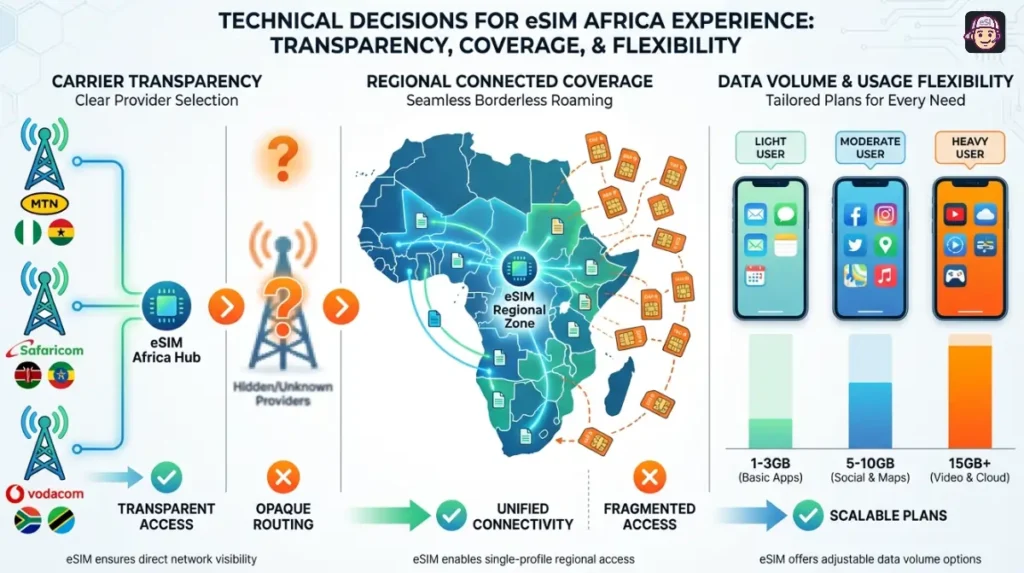
MTN, Vodacom, and Safaricom are the three names that determine quality across Africa's most-visited destinations. MTN covers South Africa, Nigeria, Ghana, Rwanda, and Uganda at scale. Safaricom is the only carrier with consistent LTE inside Kenya's national parks.
Vodacom leads in South Africa's eastern regions and along coastal KwaZulu-Natal. Any provider that names these carriers explicitly for your specific countries deserves serious consideration. Any provider that lists “major local carriers” without specifying which is asking you to gamble.
Start with Gigsky for South Africa, Airalo or Saily for multi-country East Africa, and Amigo for budget-focused Sub-Saharan itineraries.
2. Regional Versus Country-Specific Plan Structure
For single-country focused trips (South Africa only, or Kenya only), a country-specific plan delivers better per-GB value and tighter coverage depth.
For multi-country East Africa circuits spanning three or more nations, the price difference between a regional plan and stacking three country plans can reach $15 to $25.
Regional plans also eliminate the manual reinstallation of new QR codes at each border crossing, which matters when you are crossing between Kenya and Tanzania at a busy land crossing with limited phone battery.
3. Data Volume Matched to Your Africa Itinerary
A 3-day Nairobi business trip uses roughly 3GB across navigation, email, and WhatsApp. A 14-day Cape Town to Kruger overland with offline maps and occasional social uploads needs 8 to 12GB minimum. Game reserves have no Wi-Fi.
You are on mobile data for lodge communication, Google Maps, wildlife identification apps, and emergency contact. Providers with clean fixed-data plans and no mid-day throttle cliff, namely Saily and Amigo, handle low-Wi-Fi safari conditions better than plans with aggressive daily speed caps.
Safari Travellers Ask About eSIM for Africa
Does an eSIM work inside game reserves and national parks?
Coverage inside reserves depends on your provider's carrier partner. In Kenya's Masai Mara, only Safaricom delivers usable LTE. At Kruger in South Africa, MTN and Vodacom cover main rest camps but thin out in remote bush areas. Download offline Google Maps and WhatsApp offline contact details before entering any reserve.
Which eSIM for Africa has the best coverage overall?
Gigsky leads for South Africa through direct MTN, Vodacom, and Cell C access. For multi-country East Africa coverage spanning Kenya, Tanzania, and Rwanda, Saily's single reusable profile and Airalo's 29-country regional plan are the most field-consistent options tested.
How much does an eSIM for Africa cost?
Plans start from $5 for entry bundles and reach $79 for 10GB over 30 days. A practical 5 to 10GB regional Africa plan for a 2-week trip costs between $20 and $45 depending on the provider. Codes ESIMDUDE save 15% on Gigsky, 10% on Saily, and 12% on Amigo.
Is an eSIM for Africa legal to use?
eSIM technology is fully legal throughout Africa. All listed providers operate as licenced MVNOs or through licenced carrier partnerships with MTN, Airtel, and Vodacom. Local registration is not required for tourist eSIM plans. Ensure your device is carrier-unlocked before purchasing any plan.

Choosing the Right eSIM for Africa Without the Guesswork
For South Africa specifically, Gigsky's direct MTN and Vodacom access is the most technically grounded choice on this list.
For East Africa itineraries covering three or more countries, Saily's single reusable eSIM removes the installation friction that breaks multi-country trips.
First-time Africa visitors who want a globally tested name should start with Airalo's regional plan. Maya's money-back guarantee is worth using if you are heading somewhere off the main tourist circuit.
Buy before you fly. Download offline maps before you leave city range. Africa's infrastructure surprises in both directions.
How we test eSIMs
iPhone 15 Pro Max
iPhone 17 Pro Max
Samsung Galaxy S25 ultra
iPad Pro M4
32+ eSIM Providers Tested
150+ Speed Tests Verified
10+ Countries Covered
Why You Can Trust eSIMNinja
We buy every eSIM plan with our own money — no freebies, no sponsored reviews. What you read is what we genuinely experienced.
We keep receipts. Every eSIM is personally purchased.