10 Best eSIM for Asia 2026 — Fast Coverage, Low Cost

You land at Suvarnabhumi at midnight. Roaming is switched off. The airport SIM counter has a thirty-person queue and your driver is waiting. That is the exact scenario most travellers wish they had solved at home, before the flight. An eSIM for Asia removes that problem entirely.
Asia covers everything from Tokyo's 5G subway network to rural Mekong delta routes where signal drops are routine. No physical SIM covers that range affordably. The GSMA confirmed that eSIM-capable devices crossed two billion units globally in 2025, and travellers heading to Asia are among the fastest-growing adopters.
You install an eSIM for Asia before departure, it activates when you land, and your phone connects to local carriers without a tray swap or activation code error at baggage claim.
I have tested eSIMs across Japan, Thailand, Vietnam, and Indonesia on everything from Shinkansen runs to rural Chiang Rai roads. Below are the ten best options for 2026, verified for coverage, honest pricing, and real world performance.
What Separates a Reliable eSIM for Asia from a Weak One
An eSIM for Asia is a digital SIM profile stored on your phone's embedded chip. You scan a QR code, the profile loads in two to five minutes, and your device registers on the strongest available local network once you reach your destination. No slot, no swap, no counter.
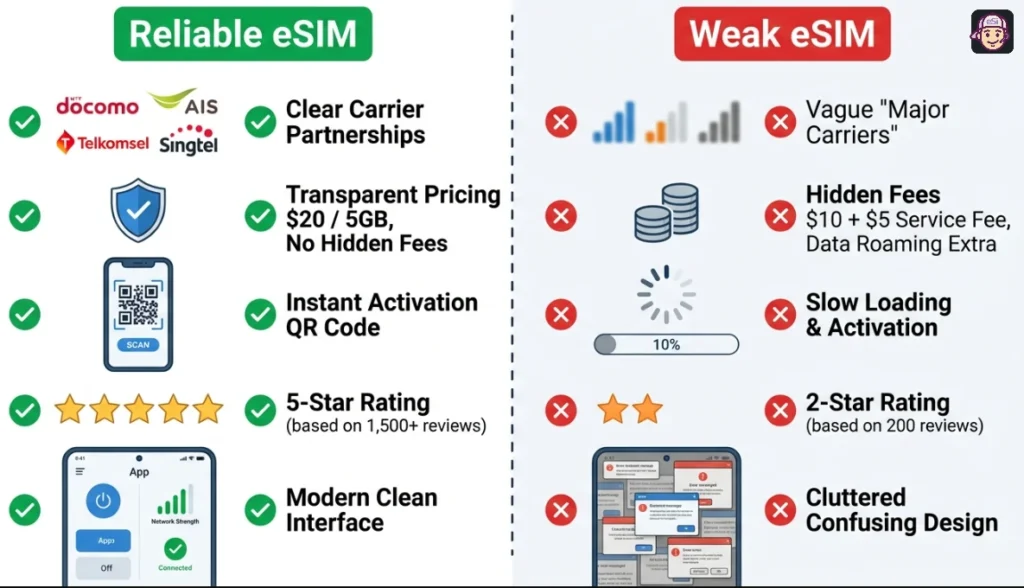
Asia's telecom landscape is among the most fragmented on earth. Japan's two dominant networks are Docomo and SoftBank. Thailand's coverage leaders are AIS and True Move. Indonesia depends on Telkomsel for anything outside Bali or Jakarta.
Singapore runs Singtel at 5G. A provider that vaguely claims major local carriers without naming them is telling you something. The best eSIM for Asia names the carrier and lets you verify before you buy.
Plan types matter just as much. A regional plan covering multiple countries beats stacking individual country plans for any trip crossing two or more borders. Data only plans suit most leisure travellers. Unlimited plans with daily caps work well for backpackers willing to accept slower speeds after the threshold. Per GB plans reward light users on short business trips.
For an eSIM for Asia covering two or more countries, a regional plan almost always costs less and causes fewer activation problems than buying separate country plans. Prioritise providers that list their local carrier partners by name and explicitly permit hotspot tethering.
10 Best eSIM for Asia 2026 Reviewed
| Asia eSIM Provider | Primary Strength | Ideal User |
|---|---|---|
| GigSky | Direct MNO, 20-country Asia | Island-hopping travellers |
| Amigo eSIM | Voice and data across Asia | Multi-region Asia trip |
| Saily | True Move Thailand access | SEA backpackers |
| Airalo | Instant QR code activation | First-time eSIM buyers |
| MobiMatter | Named-carrier marketplace | Budget data hunters |
| Billion Connect | 5G in key tech hubs | Business nomads |
| Maya | Multi-network per country | Long-stay travellers |
| Lotso Travel | Unlimited day-cap plans | Digital nomads in Asia |
| Instabridge | Lightweight urban plans | City-break visitors |
| iRoamly | 36-country Asia reach | Unpredictable itineraries |
1. GigSky
Gigsky operates as a mobile network operator rather than a reseller, which is the most important technical fact about its Asia performance. It partners directly with AIS and DTAC in Thailand, SoftBank in Japan, Telkomsel in Indonesia, and Singtel in Singapore.
That direct carrier relationship is why Gigsky holds signal in rural Chiang Mai and on Mekong valley roads where MVNO resellers frequently drop out.
The Asia Pacific plan covers 20 countries and includes cruise ship connectivity across 290 vessels-a feature genuinely unique to Gigsky among the providers on this list.
Plans run from $5 for 1GB up to a 10GB World Plan at $120.99 valid for 60 days. A reusable eSIM profile means you install once and top up on every return trip without rescanning.
👉Get GigSky for Asia
Pros
Cons
Why Gigsky for eSIM for Asia: Named carrier partnerships with Telkomsel and AIS give Gigsky a real edge in the rural patches where most eSIM providers simply do not perform. Add the cruise network and this is the strongest single profile for a mixed Asia itinerary.
2. Amigo eSIM
Amigo eSIM covers 194 destinations globally and offers something rare on an eSIM for Asia plan: voice calls and SMS on select country plans. Most Asia eSIMs are data only.
Amigo closes that gap, which matters if you need to ring a hotel in Kyoto or confirm a boat time in Halong Bay. All plans include hotspot tethering and 4G or 5G access through local carrier partners.
Country plans start from $6 and global plans from $25. A money-back guarantee reduces the risk for first-time buyers. Urban Japan, South Korea, and Southeast Asian cities all show solid LTE or 5G performance.
The one honest caveat is that voice availability varies by country rather than being universal across the Asia region.
👉Get Amigo eSIM for Asia
Pros
Cons
Why Amigo for eSIM for Asia: If your Asia trip needs one profile for data, hotspot, and occasional calls without carrying a separate SIM, Amigo is the most complete single option available.
3. Saily
Saily covers 19 countries across Asia and Oceania through local network partnerships that have been independently verified in the field. In Thailand, Saily uses True Move, one of the country's two dominant carriers.
Real world testing confirms LTE connectivity in Khao Yai National Park and stable 4G through Bangkok. In Vietnam, LTE speeds held stable enough for video streaming on the Hanoi to Ninh Binh route.
Plans start at $4.99 for 1GB and scale to unlimited tiers. Hotspot sharing is unrestricted across all plans, which is not true of every provider at this price.
Saily does not offer voice, so keep your home SIM active for calls. Auto-activation on arrival removes the manual toggle step that catches some travellers off guard.
👉Get Saily for Asia
Pros
Cons
Why Saily for eSIM for Asia: For a Southeast Asia backpacker route, Saily's True Move access in Thailand and verified LTE in Vietnam make it the most consistently tested pick at this price. The unrestricted hotspot is genuinely unlimited.
4. Airalo
Airalo introduced eSIM purchasing to millions of international travellers and remains one of the most trusted names for an eSIM for Asia among people installing their first eSIM.
The Asia regional plan covers 18 countries. The QR code install takes under three minutes, and Japan plans specifically connect through IIJ Mobile on SoftBank backbone, which is one of the cleaner network selections in the market.
The Asialink plan starts at $5 for 1GB valid for 7 days, scaling to 20GB for longer trips. Airalo works as an MVNO marketplace, so network quality depends on the carrier it has partnered with per country. Singapore via Singtel performs well. Rural Vietnam and remote Indonesia are more variable.
Pros
Cons
5. MobiMatter
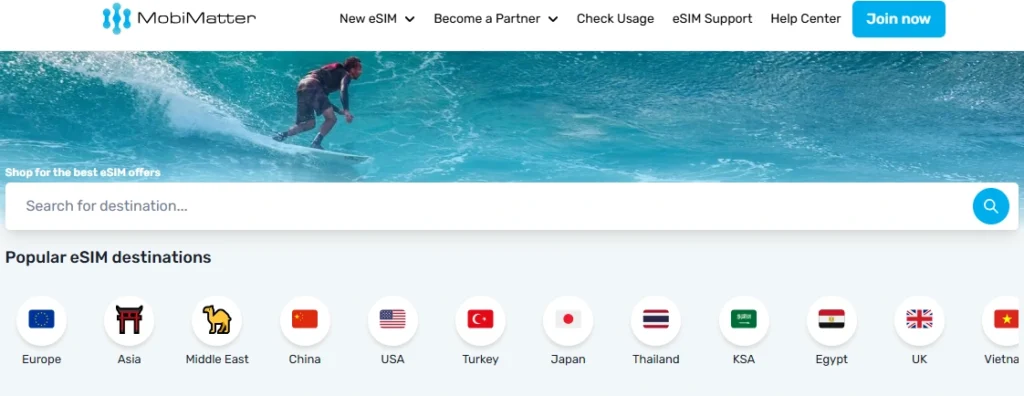
MobiMatter runs an eSIM marketplace where multiple operators list their Asia plans side by side, which gives buyers a level of carrier transparency that single-provider platforms avoid.
The Asia Premium 5GB plan at $9.99 names its carriers explicitly: TELKOMSEL in Indonesia, SINGTEL in Singapore, AIS in Thailand, MAXIS in Malaysia, MOBIFONE in Vietnam, and CHINA MOBILE in China. That named carrier list is rare at this price.
Plans range from $3.49 for 1GB across 6 countries on a 14-day window up to $54.99 for 50GB valid for 90 days at $1.10 per GB. A 365-day APAC annual plan at $43.99 for 17GB suits long-stay travellers or frequent Asia visitors.
Pros
Cons
6. Billion Connect

Billion Connect covers 200 countries and carries one of the highest app ratings in the category at 4.9 on the App Store. For an eSIM for Asia focused on Singapore, Japan, South Korea, and Taiwan, Billion Connect delivers verified 5G access in all four markets, which matters if you are running video calls or large file transfers from a coworking space in Seoul or a hotel in Tokyo.
Plans start from around $2.30 per GB for Asia coverage, with options from 300MB up to unlimited tiers. The 24/7 live chat support is a genuine differentiator for travellers who hit activation issues mid-trip. The honest limitation is that no top-up exists on current plans, so your initial size matters.
Pros
Cons
7. Maya
Maya covers 13 Asian countries on its Asia+ plan including Japan, South Korea, China, Indonesia, Thailand, Malaysia, Philippines, Singapore, Taiwan, Vietnam, Hong Kong, Australia, and New Zealand. The standout feature is multi-network access in most covered countries.
Maya connects you to the strongest of two or more available carriers rather than locking to a single partner. In Tokyo, that means Docomo-grade coverage rather than a weaker MVNO fallback.
Top-up is available directly through the account login mid-trip. Hotspot is included on all Asia plans, with location-based restrictions noted for a small number of destinations. Plans start at $3.99 and activate via QR code delivered by email.
Pros
Cons
8. Lotso Travel
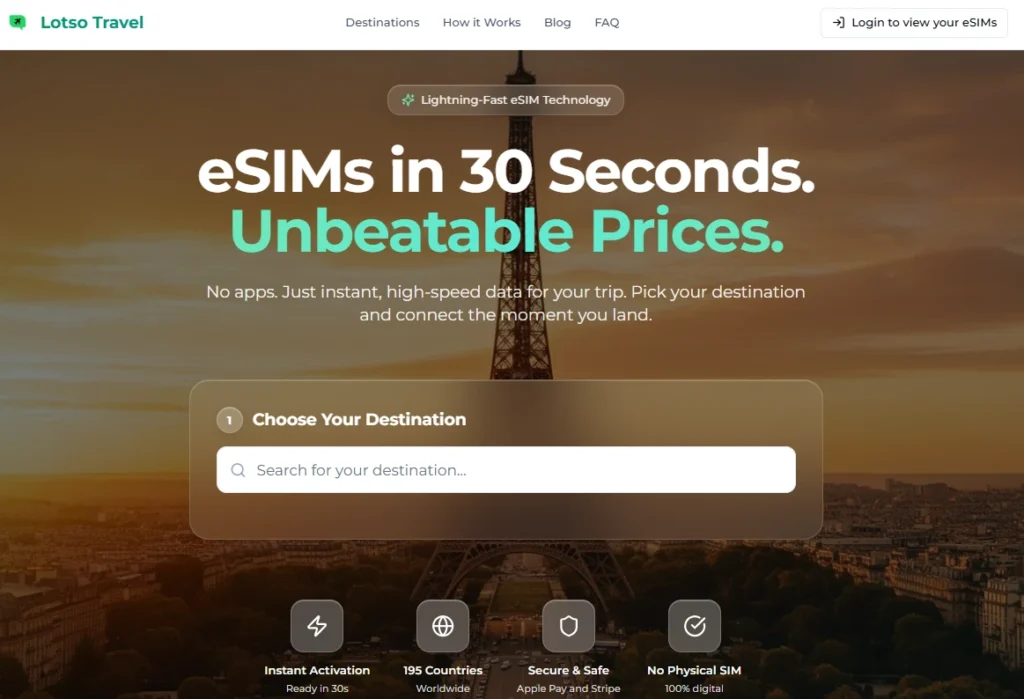
Lotso Travel offers the Asia+ plan across 11 Asian countries including China, Hong Kong, Indonesia, Japan, South Korea, Malaysia, Philippines, Singapore, Thailand, Taiwan, and Vietnam, with network partnerships at NTT Docomo and SoftBank for Japan and Singtel for Singapore.
The differentiator is its tiered unlimited structure. The Asia+ Unlimited MAX plan gives 5GB per day at full speed, then continues at 1Mbps afterwards — the kind of setup that keeps a nomad online through a full working day without hitting a dead wall.
Plans are bought without requiring an app download and activate via QR code by email. The 5-day Asia+ MAX plan starts at $23 and scales to $68 for a 30-day window. Coverage is data only with no voice or SMS.
Pros
Cons
9. Instabridge
Instabridge started as a crowd-sourced Wi-Fi network and has extended into eSIM data plans designed for urban travellers who need mobile data as a gap-filler between Wi-Fi spots.
For an eSIM for Asia itinerary concentrated in cities like Singapore, Bangkok, Tokyo, or Kuala Lumpur, the lightweight pricing structure makes practical sense.You are not paying for heavy data you will not use when hotel and café Wi-Fi covers most hours.
The app guides installation step by step and handles eSIM setup without requiring technical knowledge.
Pros
Cons
10. iRoamly
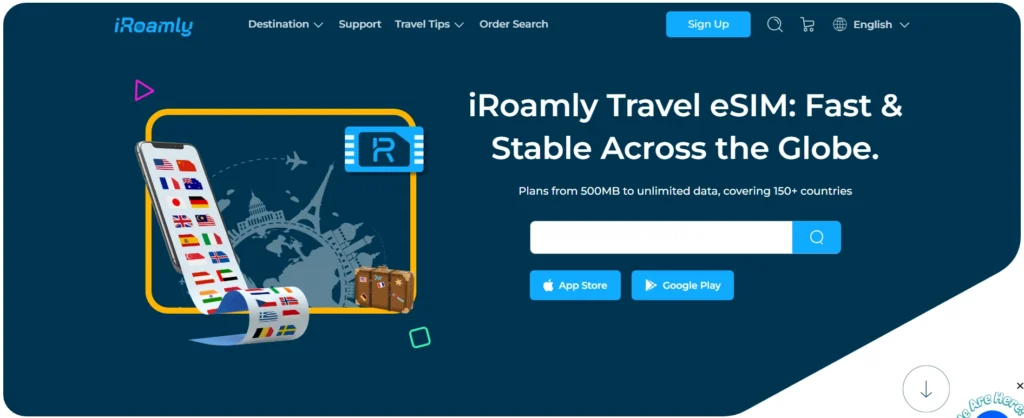
iRoamly covers 150+ countries globally and reaches 36 Asian countries on its Asia plans, including Japan, South Korea, Thailand, Vietnam, Malaysia, Indonesia, Singapore, the Philippines, Sri Lanka, India, Bangladesh, Pakistan, and the Middle East corridor.
That breadth makes it the strongest pick when your Asia itinerary runs from Southeast Asia through South Asia or into the Gulf without warning. Plan options include daily, total-data, and limited unlimited structures.
The honest trade-off is cost. Per GB pricing on a global platform is higher than a dedicated Asia regional plan. For unpredictable long-range travel, that premium is worth it. For a fixed two-week Thailand-Vietnam trip, one of the regional providers above will cost less.
Pros
Cons
How to Choose the Right eSIM for Asia Without Overpaying
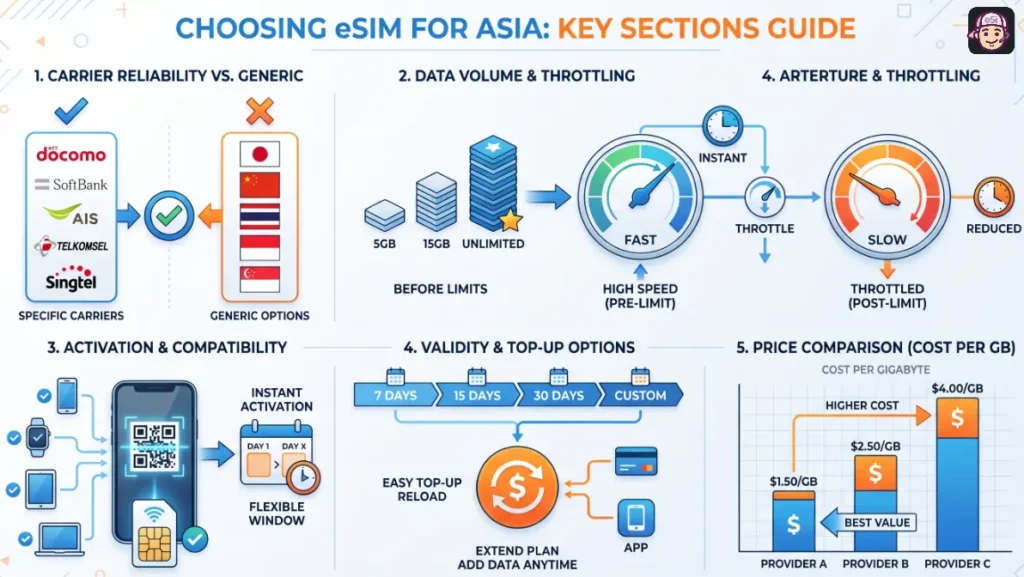
1. Carrier Names Matter More Than Country Count for eSIM for Asia
Coverage maps mean nothing if the carrier behind them is an MVNO reselling a weaker signal. AIS and True Move dominate Thailand. Telkomsel is the only operator worth relying on for rural Indonesia. Docomo and SoftBank run Japan.
Any eSIM for Asia that names these carriers in its plan specs is being transparent. Any provider that says “top local networks” without specifics is not. Gigsky and Mobimatter both publish carrier names. Verify before you buy.
2. Data Volume and Throttle Policy for Asian Travel
Three days in Singapore needs roughly 2 to 3GB. A two-week Southeast Asia backpacker trip uses 10 to 15GB with moderate streaming. Unlimited throttled plans are fine until the speed drops to 128kbps, at which point Google Maps loads slowly and video calls freeze.
Saily's unlimited reduces to 1Mbps after the daily cap — usable for messaging and maps. Lotsotravel's MAX plan holds 5GB per day before throttling.
Always read the fair use policy in the plan specs, not just the plan headline.
3. Activation Window and Device Compatibility for eSIM for Asia
Most eSIMs for Asia auto-activate on arrival. A small number require manual activation before boarding. Check the activation window in the plan description. iPhones from XS onwards support eSIM natively. Samsung Galaxy S20 and Pixel 4 and later also work.
Carrier-locked handsets from some US and Asian networks block eSIM installation entirely. Install your eSIM for Asia at home, verify the profile is listed in your settings, and you will avoid every airport-gate activation panic.
4. Plan Validity and Top-Up Access
A 7-day plan is useless on a delayed 9-day trip. Maya allows top-up mid-trip via account login. Airalo lets you purchase an additional plan on the same profile.
Mobimatter offers APAC plans valid for 365 days for repeat visitors. Match plan length to a realistic itinerary, not an optimistic one.
5. Price Per Gigabyte Compared Across Providers
Mobimatter's lowest per GB rate for Asia is $1.10 at the 50GB tier for 6 countries. Saily sits at $4.99 per GB for its 1GB plan but covers 19 countries.
The cheapest option per GB is not always the best value. A $15 Asia regional plan covering 18 countries outperforms three $7 single-country plans every time you cross a border.
FAQ — Answers to What Travellers Ask Most About eSIM for Asia
How do I install an eSIM for Asia on my iPhone?
Open Settings, tap Mobile Data, then Add eSIM. Scan the QR code from your purchase confirmation email. The profile downloads in about two minutes. Enable the eSIM, switch on data roaming, and set it as your mobile data line. It activates automatically when your phone registers on the local network at your destination.
Which eSIM for Asia has the best rural coverage?
Gigsky performs most consistently in rural Asia because of its direct partnerships with Telkomsel in Indonesia and AIS in Thailand, both of which dominate rural network infrastructure in those countries. Saily via True Move also holds signal outside Bangkok into national parks and provincial areas. Avoid MVNO-only providers for trips to remote Mekong regions or rural Japanese mountain routes.
How much does an eSIM for Asia cost?
Asia eSIM plans start from $3.49 for 1GB on a 14-day window on Mobimatter, $4.99 for 1GB across 19 countries on Saily, and $5 for 1GB across 20 countries on Gigsky. A 10GB plan covering major Southeast Asian countries typically runs $15 to $22. Unlimited throttled plans start around $15 for 5 days.
Is it legal to use an eSIM for Asia in all countries?
eSIM use is permitted in Japan, South Korea, Thailand, Singapore, Malaysia, Indonesia, Vietnam, and the Philippines. China allows eSIM data connections on eligible plans, though certain platforms require a VPN regardless of SIM type. Always check your destination's current regulations before travel, as policies update periodically.
Can I keep my home phone number active alongside an eSIM for Asia?
Yes. Most smartphones from 2020 onwards support dual SIM or eSIM alongside a physical SIM simultaneously. Keep your home SIM in the tray for calls and messages. Set the eSIM for Asia as your mobile data line. Your home number stays reachable while your browsing runs at local Asia speeds.
Does GigSky offer a free trial for Asia eSIM?
Gigsky provides a 100MB free trial on registration, which is enough to confirm your phone is compatible and test the activation process before committing to a paid plan. Most other providers on this list do not offer free trials for Asia, though Amigo's money-back guarantee provides equivalent reassurance.

Final Thoughts on Choosing an eSIM for Asia
Gigsky is the most dependable pick for anyone who needs named carrier access across 20 Asian countries and may mix land travel with a cruise itinerary. Amigo earns its place for travellers who need the occasional voice call alongside data.
Saily is the most field-tested choice for Southeast Asia with its True Move access and unrestricted hotspot. Mobimatter rewards careful buyers who are willing to compare marketplace plans and want the lowest per GB rate at volume.
For lighter city trips, Instabridge keeps the bill small. For itineraries that push beyond Southeast Asia into South Asia or the Gulf, IRoamly's 36-country reach removes the plan mismatch problem. Every provider here solves a specific travel problem. Choose the one that fits your actual route.
How we test eSIMs
iPhone 15 Pro Max
iPhone 17 Pro Max
Samsung Galaxy S25 ultra
iPad Pro M4
32+ eSIM Providers Tested
150+ Speed Tests Verified
10+ Countries Covered
Why You Can Trust eSIMNinja
We buy every eSIM plan with our own money — no freebies, no sponsored reviews. What you read is what we genuinely experienced.
We keep receipts. Every eSIM is personally purchased.