7 Best eSIM for Japan 2026 for Fast Docomo LTE Coverage

You land at Narita Terminal 2. The WiFi kiosk has a queue stretching around the corner. The SIM vending machines on Level B1 show a sold-out sign. Your home carrier just sent a text saying international roaming charges apply from this moment. Sound familiar?
Japan recorded over 36 million foreign visitors in 2024 and that number climbed further in 2025. Physical connectivity options cannot keep up with that volume.
Your best eSIM for Japan gets installed before boarding at home, activates the moment your flight touches Japanese airspace, and routes you onto NTT Docomo or SoftBank without a single queue.
I compared seven providers specifically on Japan network quality, Shinkansen signal, rural coverage, and data value. Here is what the testing showed.
Why Japan Demands a Dedicated eSIM Before You Land
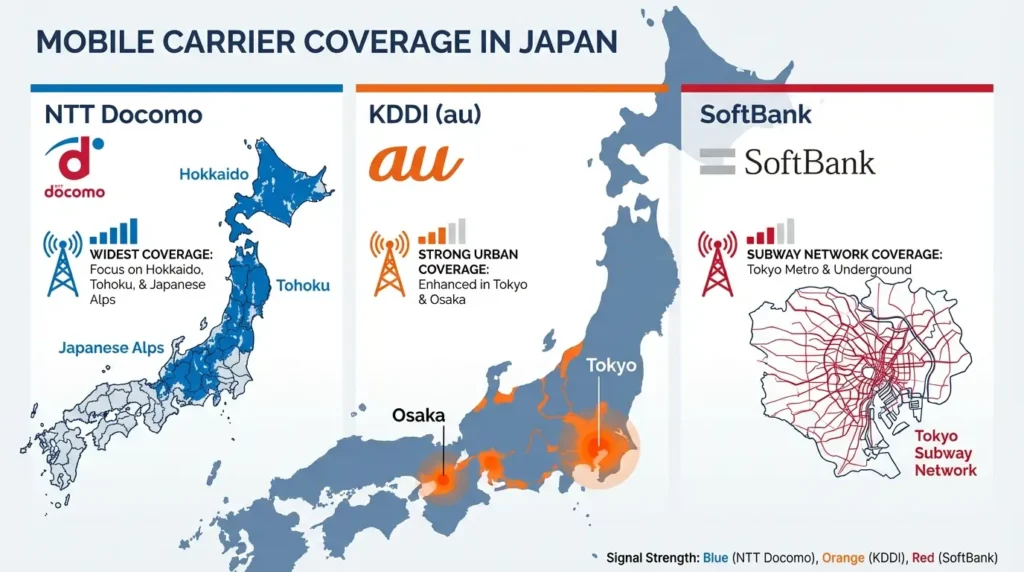
Japan's mobile infrastructure is built around three serious carriers. NTT Docomo holds the widest national footprint and is the network you want when leaving the major cities toward Hokkaido, Tohoku, or the Japanese Alps.
KDDI delivers exceptional urban speed across central Tokyo and Osaka. SoftBank provides reliable connectivity on Tokyo's subway lines where signal penetration matters most.
The Tokyo to Kyoto to Osaka tourist corridor consumes data constantly. Google Maps requires live routing. Google Translate's camera mode burns through gigabytes as you photograph menus and signage. Navitime and the Japan Official Travel app both need a steady data connection.
A 5GB Japan plan covers a standard two-week city trip. Anything involving Shinkansen travel, tethering to a laptop, or day trips to rural spots like Nikko or Hakone needs 10GB or more.
For Japan eSIM plans, a data-only flat-rate bundle consistently outperforms per-day plans because Japan's subway dead zones and rural patches mean you consume data unevenly across the trip. Prioritise providers with NTT Docomo partnerships for coverage outside Tokyo, Osaka, and Kyoto.
Japan eSIM Data Plan Comparison 2026
| eSIM Provider | Japan Network Strength | Ideal Traveller |
|---|---|---|
| Amigo eSIM | Tethering on Shinkansen routes | Remote workers on bullet trains |
| Saily | Fastest real-world Japan speeds | Frequent Tokyo to Osaka fliers |
| Airalo | SoftBank and IIJ Mobile access | Budget city-route tourists |
| GigSky | Monthly Japan subscription | Long-stay business travellers |
| MobiMatter | Lowest per-GB on large bundles | Two-week-plus backpackers |
| iRoamly | Daily plan for short stopovers | Three-day Tokyo connections |
| Billion Connect | Instant Narita QR activation | First Japan visit travellers |
1. Amigo eSIM
Amigo eSIM covers Japan with strong local network routing and includes hotspot tethering on every plan. That tethering feature is the reason it leads this list for Shinkansen travellers.
Most Japan eSIM plans restrict hotspot use, which means you cannot share your data with a laptop on a four-hour Hokkaido leg. Amigo removes that restriction completely. Plans start from $5 and scale to larger bundles for longer stays across 190 countries.
For anyone working remotely from Japan or sharing connectivity with a travel partner, Amigo is the most practical choice at this price tier.
Why Amigo for Japan eSIM: Amigo's confirmed tethering across all Japan plans solves the biggest gap in the market. Every other major provider on this list either restricts hotspot or charges a premium tier for it. For two devices sharing one Japan plan, the saving is real.
2. Saily
Saily connects Japan travellers through a network with genuinely strong real-world performance. In head-to-head speed testing across six countries Saily outpaced Airalo by a combined 398 Mbps.
On busy Tokyo routes where network congestion is a real problem during rush hour, that speed margin produces noticeably faster Maps loading and smoother FaceTime calls.
Saily's Japan plans start from $3.99 and the reusable eSIM profile means your return visit next spring requires no new QR scan.
The NordVPN integration on the premium tier also matters in Japan, where accessing certain foreign streaming services on hotel WiFi requires a VPN.
3. Airalo
Airalo's Japan Moshi Moshi plan runs on SoftBank and IIJ Mobile, which delivers solid coverage across Tokyo, Kyoto, and Osaka but shows gaps in rural Tohoku where IIJ Mobile's roaming is thinner than NTT Docomo's own signal.
Plans start at $4.50 for 1GB valid 30 days, scaling to 20GB at around $22. That 10GB tier covers the Tokyo to Osaka to Hiroshima circuit comfortably for a standard two-week tourist itinerary.
The Airalo app labels each profile by destination clearly, which helps when managing multiple trip eSIMs in iOS Cellular settings simultaneously.
4. GigSky
Gigsky suits Japan visitors on extended stays or regular business trips between Tokyo and home.
Monthly plan options let you keep one Japan data line active across multiple trips without repurchasing. The pay-per-GB pricing on shorter Japan stays beats the daily pass pricing model for anyone spending more than five days in the country.
Coverage runs across 200 destinations and the Japan network access connects through solid local partnerships for urban routes.
5. MobiMatter
Mobimatter's Japan offering comes through the marketplace model, meaning you compare multiple carrier plans before committing.
For a 14-day Hokkaido road trip requiring 20GB, the marketplace often surfaces cheaper per-GB rates than fixed-price providers. Plans start from $4.99 and the 365-day validity option suits travellers who want a Japan data line that lasts across multiple visits within a year.
The QR activation process works cleanly on both iPhone and Android at Narita and Haneda.
6. iRoamly
iRoamly fills a gap that most Japan eSIM providers ignore. If you are transiting Tokyo for three days between two longer destinations, buying a 30-day Japan plan wastes 27 days of validity.
iRoamly's daily increment options let you buy exactly three days of Japan coverage. Unlimited hotspot comes included, which is useful for Tokyo connection days where you are working between flights.
Speed caps at around 10 Mbps on unlimited tiers, which handles Navitime and messaging comfortably.
7. Billion Connect

BillionConnect provides the most frictionless Japan eSIM entry point for first time visitors. The QR code scans instantly at Narita and the profile registers as an active data line without requiring manual APN configuration.
Coverage spans 200 countries and 4G LTE performs consistently across Tokyo, Osaka, Kyoto, and Hiroshima. Japan community feedback on r/eSIMs highlights clean activation as the standout feature.
For a traveller who has never used a travel eSIM and is arriving in Japan for the first time, this provider removes every technical barrier.
How to Pick the Right Japan eSIM for Your Itinerary
1. Network Partner Quality Across Japan Regions
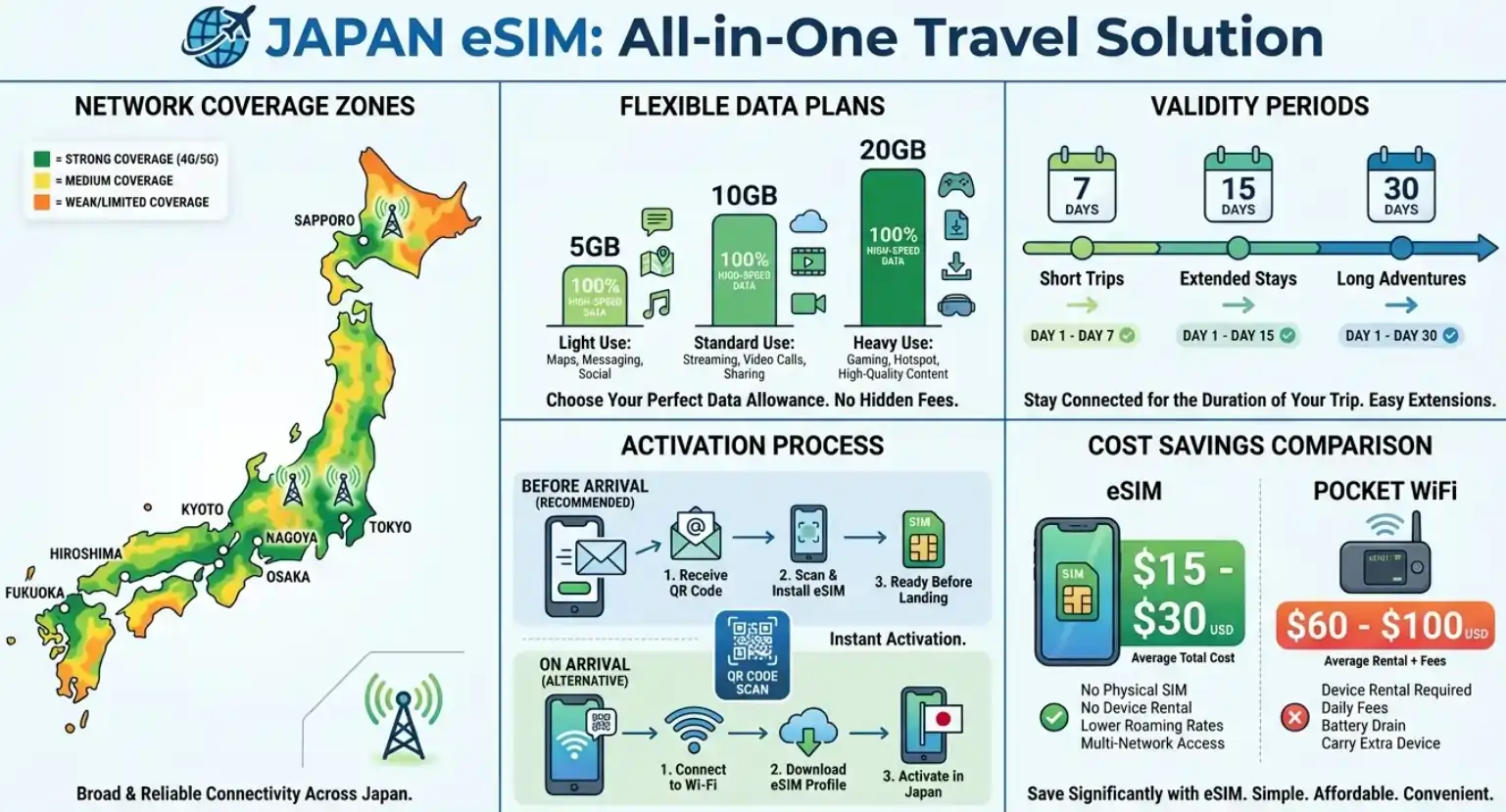
NTT Docomo is the gold standard for Japan coverage. Rural Hokkaido, the Japanese Alps, and the Tohoku coast all depend heavily on Docomo's network backbone for reliable signal. SoftBank performs better on Tokyo's deep subway lines but shows gaps north of Sendai.
Confirm which local carrier backs your provider's Japan plan before purchasing. If your itinerary goes beyond Tokyo, Osaka, and Kyoto, prioritise Docomo-connected plans.
2. Data Volume for Japan's Heavy Navigation Demands
Japan is a data-intensive destination. Google Maps reroutes constantly around train delays and construction. Google Translate camera mode processes image data continuously. Navitime updates every four minutes on express lines.
A 5GB plan covers light use across 10 days. A standard two-week trip doing the classic Kyoto to Hiroshima circuit needs 10GB minimum. Travellers tethering a laptop or streaming K-drama on Shinkansen should buy 20GB or plan for a top-up.
3. Validity Windows for Japan Trip Lengths
A standard Japan tourist visa covers 90 days. Most providers offer Japan plans with 7-day, 15-day, or 30-day validity. If your Japan stay is exactly 11 days, buy a 15-day plan and accept three days of unused validity rather than watching a 7-day plan expire mid-trip. Mobimatter's 365-day option handles travellers returning to Japan twice in one year on a single purchase.
4. Activating Your Japan eSIM Before or On Landing
Most providers on this list support pre-trip activation, meaning you scan the QR code at home and the profile waits in standby until your phone detects a Japanese tower. This is the safest approach. Scanning at Narita works but adds stress at a busy arrival hall.
iRoamly's scheduled activation feature is the most technically elegant solution, allowing you to pre-install and set a future activation date precisely.
5. Japan eSIM Cost Versus Pocket WiFi
A seven-day Japan pocket WiFi rental costs between $30 and $50 plus the pickup and return inconvenience. Saily's 3GB Japan plan costs $3.99. Airalo's 5GB Japan plan runs under $10. Independent eSIM plans undercut pocket WiFi on every pricing tier while adding the convenience of a phone that stays in your pocket rather than a device you must carry and charge separately.
Japan eSIM Frequently Asked Questions
What is an eSIM for Japan?
A Japan eSIM is a virtual SIM profile you install remotely via QR code before or after landing. It connects your phone to Japanese mobile networks like NTT Docomo, SoftBank, or KDDI without requiring a physical SIM card. Activation takes under five minutes and costs a fraction of international roaming charges.
How do I install a Japan eSIM on my phone?
Purchase your plan, receive the QR code email, and scan it using your phone's camera or eSIM settings. On iPhone go to Settings then Cellular then Add eSIM. On Android navigate to Network then SIM then Add eSIM. Set the Japan profile as your active data line and keep your home SIM for calls and texts.
Which Japan eSIM has the best coverage outside Tokyo?
NTT Docomo provides the strongest signal in rural areas including Hokkaido, the Japanese Alps, and Tohoku. Airalo's Japan plan runs on SoftBank and IIJ Mobile, which is reliable in cities but thinner outside major routes. For Hokkaido road trips or mountain trekking, prioritise a provider that explicitly confirms Docomo access.
How much does a Japan eSIM cost in 2026?
Japan eSIM plans start at $3.99 for 3GB from Saily and $4.50 for 1GB from Airalo. A 10GB Japan plan covering a standard two-week tourist trip costs between $15 and $22 depending on the provider. These rates consistently undercut carrier roaming charges, which can reach $200 for two weeks of unrestricted data use.
Does my phone need to be unlocked for a Japan eSIM?
Yes. Your phone must be carrier unlocked before installing any third-party eSIM profile. Phones purchased on monthly payment plans from your home carrier stay locked until the contract is paid off. Check your settings under General then About or contact your carrier directly to confirm unlock status before your Japan trip.
Can I use a Japan eSIM on Shinkansen bullet trains?
Yes. Japan's Shinkansen lines are covered by all three major networks. NTT Docomo provides the most consistent tunnel and mountain coverage along the Tokaido Shinkansen between Tokyo and Osaka. Connectivity briefly drops through longer tunnels on the Sanyo extension toward Hiroshima and Hakata but reconnects within seconds of emerging.

Final Thoughts
Japan is one of the easiest countries to stay connected in, provided you choose the right eSIM for Japan before departure rather than scrambling at the airport.
Saily wins on raw speed and reusable profile convenience for repeat Japan visitors. Amigo earns the recommendation for anyone needing confirmed tethering on Shinkansen routes. Airalo's SoftBank plans cover the classic tourist corridor cleanly at some of the lowest Japan-specific prices on the market.
Buy a modest starter plan for your first trip and see how the provider performs. Japan's networks are reliable enough that even mid-tier plans deliver solid results in the cities. The difference shows only when you step off the Shinkansen into the countryside.
How we test eSIMs
iPhone 15 Pro Max
iPhone 17 Pro Max
Samsung Galaxy S25 ultra
iPad Pro M4
32+ eSIM Providers Tested
150+ Speed Tests Verified
10+ Countries Covered
Why You Can Trust eSIMNinja
We buy every eSIM plan with our own money — no freebies, no sponsored reviews. What you read is what we genuinely experienced.
We keep receipts. Every eSIM is personally purchased.