8 Best eSIM for South America 2026: Full Coverage Guide

Picture this. You land in Bogotá, roaming is on by accident, and forty-eight hours later your carrier sends a $180 bill for four days of casual Google Maps use. It happens constantly to travellers unprepared for South America's expensive roaming environment.
South America stretches from the Atacama Desert to the Amazon basin, from Argentina's Patagonian steppe to Colombia's Pacific coast.
A single physical SIM card bought at El Dorado airport covers one country. Cross into Peru, and you are starting over.
An eSIM for South America solves that problem with one installation before you fly. The continent's primary carriers — Claro, Vivo, Movistar, and Entel — are the networks that actually matter here, and the best providers partner with at least three of them.
I have run speed tests on eSIMs in Medellín, Cusco, Buenos Aires, and São Paulo. The eight picks below are the ones that hold up when the itinerary gets complicated.
eSIM for South America vs Local SIM — Why the Data Favours eSIM in 2026
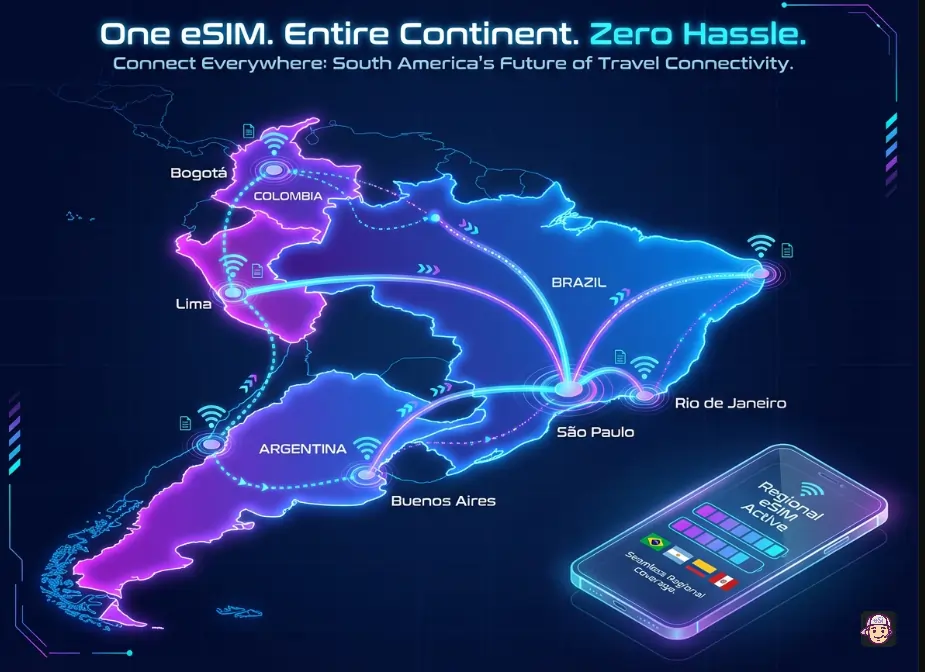
Getting a local SIM in Brazil means showing a CPF number (a Brazilian tax ID most foreign tourists do not have) or queuing at a Vivo or Claro store with a passport.
Argentina's SIM registration process requires documentation and varies by province. In Peru, local SIM counters at Jorge Chávez airport sell out during peak season.
An eSIM for South America bypasses all of that. You buy online, receive a QR code by email, install at home, and the profile activates the moment your phone registers on a local carrier at your destination. No documentation. No queues. No counter to find.
The regional multi-country plan is the most practical plan type for South America. Most itineraries touch at least Brazil, Argentina, and Colombia on a single trip. Buying separate country eSIMs for each costs more and requires reinstalling profiles across borders. A regional plan follows you from the moment you land at your first destination to the moment you depart your last.
For an eSIM for South America covering multiple countries, look for plans that explicitly partner with Claro (active in nine South American countries), Vivo in Brazil, and Movistar across the Andes corridor. Those three networks together cover the vast majority of realistic traveller routes.
Who Should Read This — Match Your Travel Type to the Right eSIM for South America
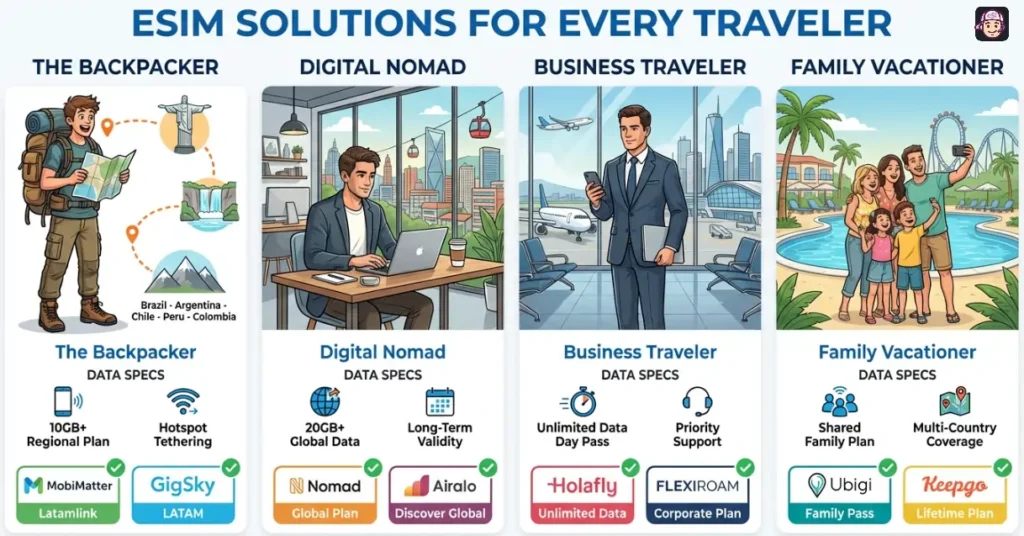
Rather than a generic table, here is the realistic audience breakdown for this keyword and which providers match each profile.
The Backpacker Route (Brazil → Argentina → Chile → Peru → Colombia) needs a regional plan with 10GB+ and hotspot tethering. Mobimatter's Latamlink or Gigsky's LATAM plan suits this.
The Medellín or Buenos Aires Digital Nomad needs 20GB minimum, stable LTE in city coworking districts, and mid-trip top-up. Amigo or Mobimatter at volume pricing.
The Machu Picchu Short-Break Tourist needs 5GB, Peruvian carrier coverage at altitude, and quick QR install. Airalo or Saily handles this cleanly.
The Cruise-and-Land Mixed Itinerary needs a provider with both land and maritime coverage. Gigsky is the only provider on this list offering both across South America.
eSIM for South America Signal Comparison by Country 2026
| South America eSIM Provider | Plan Types Available | Countries Covered |
|---|---|---|
| Amigo eSIM | Regional, country, global | 194+ |
| GigSky | Regional, cruise, fixed-data | 16 (LATAM) |
| Saily | Regional, fixed-data | 12 |
| Airalo | Regional, global, country | 14 (LATAM) |
| MobiMatter | Marketplace, fixed-data | 15–17 (LATAM plans) |
| iRoamly | Global, daily, per-data | 150+ |
| Lotso Travel | Daily-cap, unlimited tiers | 195+ |
| Billion Connect | Country, unlimited, global | 200+ |
1. Amigo eSIM
Amigo eSIM covers 194+ destinations and its Latin America plan connects to the strongest available carrier in each country automatically, which is a genuine advantage in South America where carrier dominance shifts by nation.
Independent speed testing in Bogotá recorded 129 Mbps download and 29.9 Mbps upload — the fastest logged result in Colombia across any provider in that test period.
Unlimited hotspot is included on every plan, making this the practical choice for a nomad running a laptop off a mobile connection in a Medellín café. Voice calls and SMS are available on select country plans, an option most competitors on this list do not offer for South America.
👉Get Amigo eSIM for South America
Why Amigo for eSIM for South America: No other provider on this list combines auto-carrier switching, unlimited hotspot, and voice capability on a single Latin America plan. For a Medellín nomad or a multi-country backpacker, that combination is difficult to match.
2. GigSky
GigSky's LATAM plan covers 16 South and Central American countries including Argentina, Bolivia, Brazil, Chile, Colombia, Ecuador, Peru, Paraguay, and Uruguay through direct MNO partnerships rather than MVNO reselling.
The 100GB plan runs $229.49 valid for 180 days, and the 50GB plan is $152.99 over 90 days — pricing that makes sense for long-stay travellers doing the full Patagonia to Cartagena circuit.
The standout is the Cruise + Americas plan, which extends connectivity across Caribbean and South American cruise routes. If your itinerary mixes a Buenos Aires stay with a Antarctica-bound cruise or a Colombian coastal sailing trip, no other provider handles that in a single profile.
👉Get GigSky for South America
Why Gigsky for eSIM for South America: Patagonia to Cartagena with a coastal cruise in between — that is the itinerary Gigsky was built for. Direct MNO access plus maritime coverage is a combination no other provider on this list offers.
3. Saily
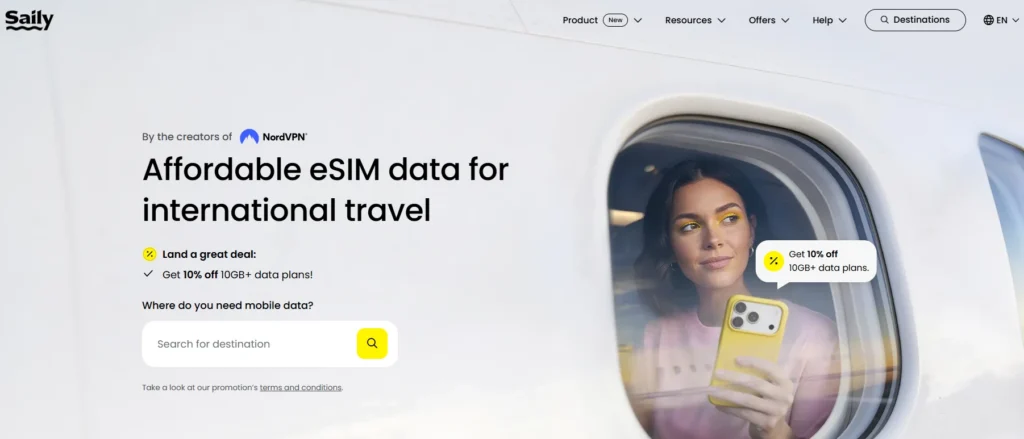
Saily's Latin America plan covers 12 countries – Brazil, Argentina, Chile, Colombia, Peru, Costa Rica, Ecuador, Uruguay, Paraguay, El Salvador, Bolivia, and Mexico -through local 4G/LTE/5G networks.
Plans include 1GB for 7 days at $13.99, 2GB for 15 days at $26.99, and 5GB for 30 days at $57.99. Auto-activation on arrival in the first covered country removes one common setup error.
Hotspot sharing is unrestricted. The data only limitation means you rely on WhatsApp for calls, which is effectively standard practice across South America anyway – the continent is deeply WhatsApp-dependent for local communication.
👉Get Saily for South America
Why Saily for eSIM for South America: For a classic South America backpacker route hitting Brazil, Argentina, Chile, Peru, and Colombia, Saily's clean auto-activation and unrestricted hotspot deliver a reliable experience without technical fuss.
4. Airalo
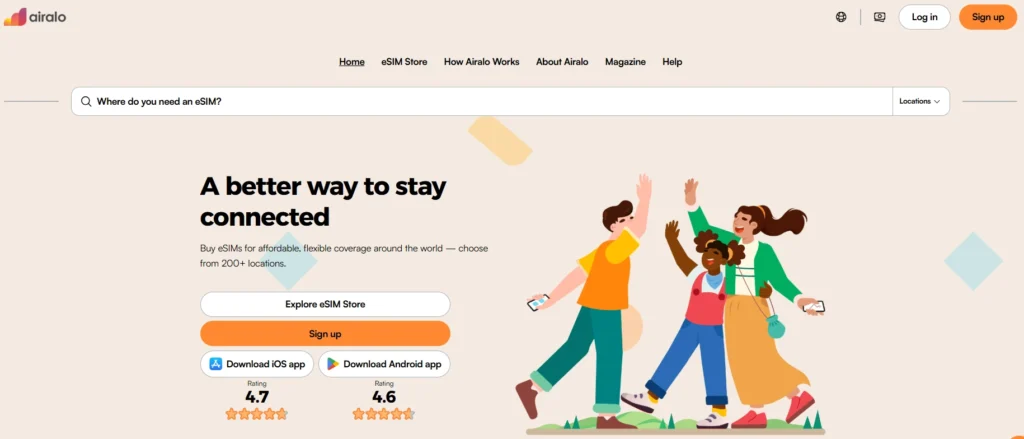
Airalo's Latin America regional plan connects through Claro, Movistar, and Vivo depending on the country – a named carrier lineup that covers the most important networks in the continent's four largest markets.
Independent travellers in Reddit communities covering South America consistently report solid coverage in Brazil and Argentina on Airalo's global plan, which at 3GB for 30 days at $24 undercuts the dedicated Latin America plan at $39 for 3GB.
That global plan arbitrage is worth knowing. The QR code install takes under three minutes and works from the Airalo app or your email.
5. MobiMatter
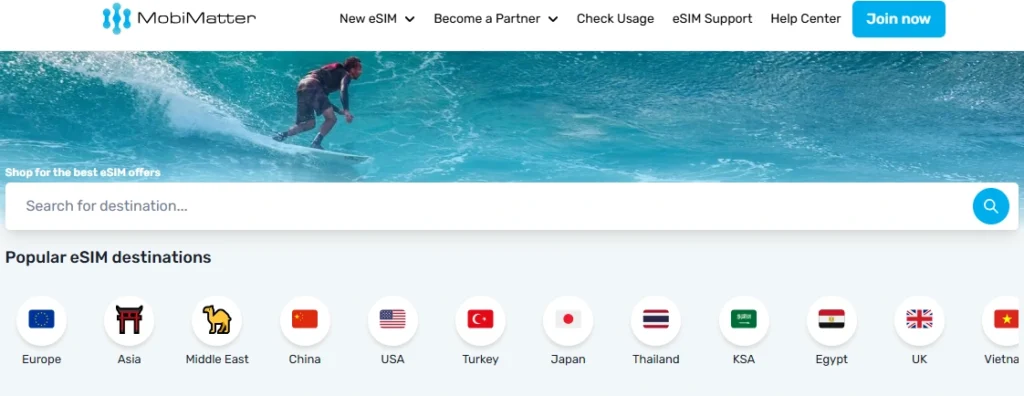
MobiMatter's marketplace approach means you compare multiple LATAM plans before committing, and the carrier transparency here is better than most.
The LatAmlink 10GB plan connects through Movistar in Argentina and Chile, Vivo in Brazil, and Claro in Colombia — all named. The 20GB Latamlink plan at $54.99 valid for 30 days works out at $2.75 per GB.
The Americas 35GB plan runs $43.99 for 365 days, which makes practical sense for anyone splitting extended time between South America and North or Central America on a single purchase.
6. iRoamly
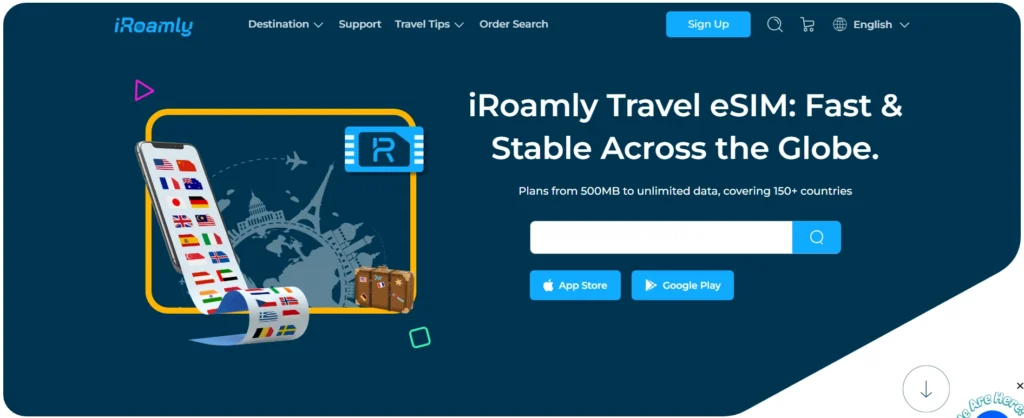
iRoamly covers South America within a global eSIM framework that spans 150+ countries, which is the feature that matters most for travellers whose South America leg is part of a larger round-the-world trip.
Brazil, Argentina, Colombia, Chile, and Peru all sit within the plan coverage. The pay-as-you-go daily and total-data plan options mean you are not locked into a regional bundle that may not match a shortened or extended itinerary.
For a traveller finishing South America and continuing to Europe or West Africa on the same eSIM profile, IRoamly removes the reinstall step.
7. Lotso Travel
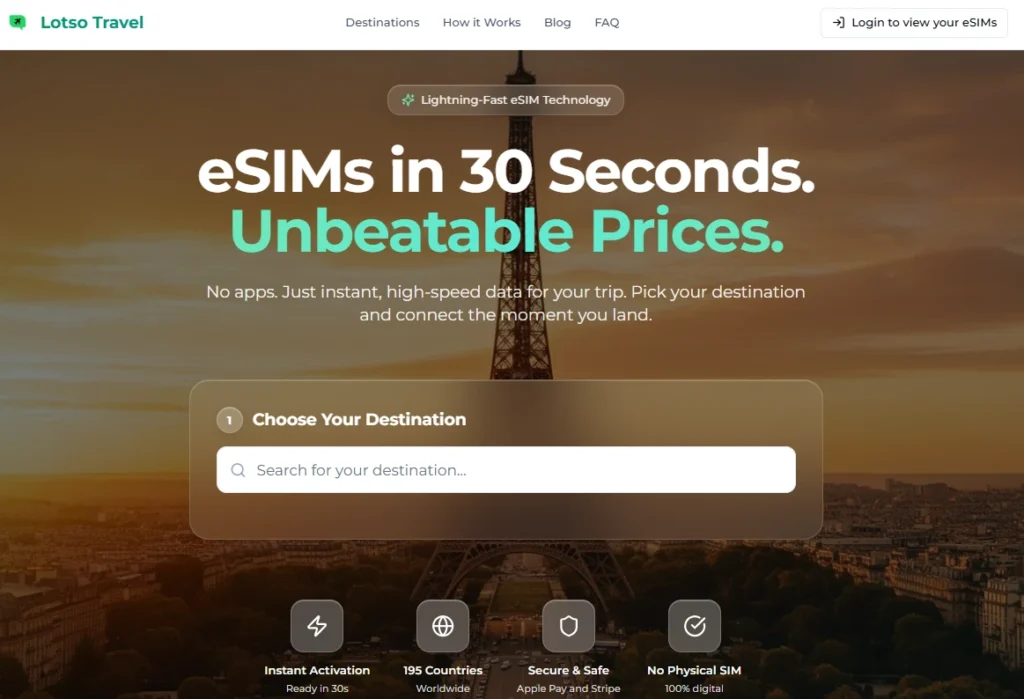
Lotso Travel's coverage map includes 195+ countries and the platform offers tiered daily-cap unlimited plans that suit a different type of traveller than fixed GB bundles.
For a digital nomad based in Buenos Aires or Medellín for a month who needs a daily high-speed allowance then continued slower connectivity for messaging, that structure fits the work pattern well. Checkout does not require an app download, which speeds up the purchase flow on a travel day.
8. Billion Connect
Billion Connect brings its 200+ country reach into South America with 5G access confirmed in major city hubs.
For business travellers on short São Paulo or Bogotá visits who need video call quality on the go, Billion Connect's 4.9 App Store rating and 24/7 live chat support reduce the activation risk that other providers leave unaddressed.
Plans run from small data bundles up to unlimited tiers, and the global footprint means any post-South America travel is covered without switching eSIM provider.
Four Things That Determine Your eSIM for South America Performance
1. Carrier Name Verification Before Purchase
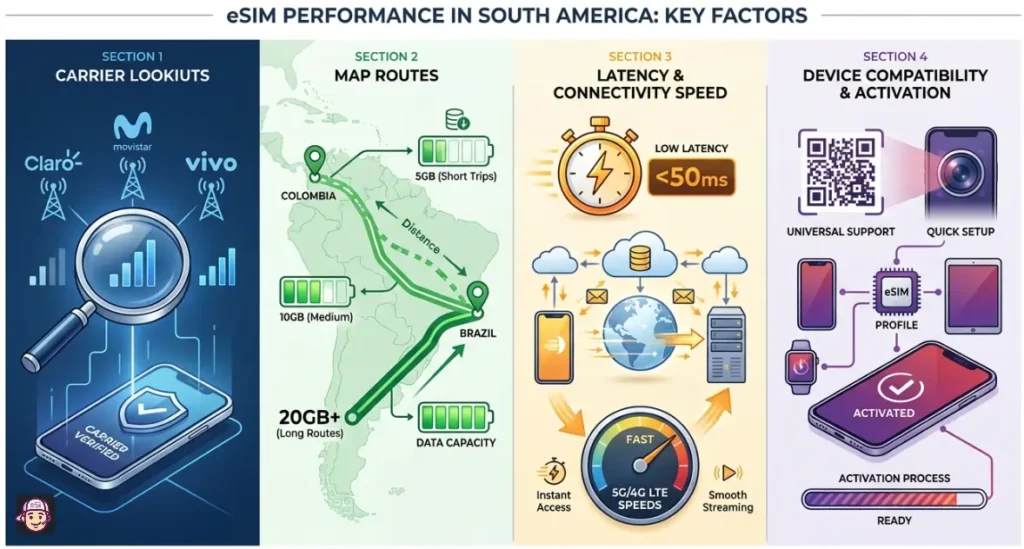
South America's network quality is not uniform. Claro dominates in Colombia and Chile. Vivo and Claro split Brazil.
Movistar holds strength across the Andes corridor in Argentina, Peru, and Chile. Any eSIM for South America worth trusting names these carriers in the plan description.
GigSky and MobiMatter both publish carrier partners. If a provider only says “local networks,” ask them directly before buying.
2. Data Volume Matched to Your Route Type
Three days in Cartagena needs 2 to 3GB. A full six-week Patagonia to Cartagena circuit needs 15GB or more, especially with Google Maps running constantly through areas with poor offline map data.
Anyone working remotely from Buenos Aires or Medellín for a full month needs 20GB minimum. Match your plan size to the realistic use case, not the optimistic one.
3. Altitude and Remote Coverage Expectations
The Inca Trail to Machu Picchu sits at 2,430 to 4,215 metres. The Bolivian altiplano reaches 3,800 metres.
Amazon basin routes have genuine signal gaps regardless of provider. No eSIM for South America delivers full coverage in these environments. Providers using direct MNO access (Gigsky) perform better in altitude and remote zones than MVNO-only alternatives.
4. Top-Up Availability Mid-Trip
South America trips routinely run longer than planned. A provider with mid-trip top-up through an app (Airalo, Maya) removes the anxiety of running out of data on a bus somewhere between Santiago and Mendoza.
A provider that requires a full new purchase for each data reload is inconvenient when connectivity is already patchy.
Questions Travellers Ask Before Buying an eSIM for South America
How do I set up an eSIM for South America on my phone?
Purchase a plan, receive your QR code by email, go to Settings then Mobile Data then Add eSIM, and scan the code. Enable roaming. The eSIM activates when your device registers on a local network at your destination. The whole process takes under five minutes. Complete it at home, not at the airport.
Which eSIM for South America has the best coverage in rural areas?
GigSky performs most reliably in rural South America because of its direct MNO partnerships rather than MVNO reselling. Amigo's auto-carrier switching also performs well by selecting the strongest available signal per country. Avoid relying on any eSIM for deep Amazon basin or high-altitude Bolivian routes without offline maps downloaded first.
How much does an eSIM for South America cost?
Prices range from $13.99 for Saily's 1GB/7-day Latin America plan to $54.99 for MobiMatter's Latamlink 20GB/30-day plan. Airalo's global plan offers 3GB for 30 days at $24 and often works out cheaper than the dedicated Latin America plan for the same countries. Budget for $30 to $60 for a full two to three week South America trip.
Do I need a local SIM in Brazil or can an eSIM replace it?
An eSIM fully replaces a local Brazilian SIM for data purposes. Brazil's SIM registration requirement (CPF number) makes buying a local physical SIM difficult for foreign tourists. An eSIM for South America bypasses this entirely. You install before flying and access Vivo or Claro-backed data from touchdown. Keep your home SIM active in the tray for any calls.
Is an eSIM for South America legal in all countries?
eSIM use is legal and fully supported in Brazil, Argentina, Colombia, Chile, Peru, Ecuador, Uruguay, Bolivia, and Paraguay. Venezuela permits eSIM connections though plan availability varies by provider. Always verify the latest rules before visiting any country, as regulations update periodically.

The Right eSIM for South America Is a Simple Decision
For most multi-country routes, the choice sits between three options. Amigo works best when you need auto-carrier switching and the option of voice on certain country plans.
GigSky earns its place on any itinerary mixing land travel with coastal cruising, thanks to its LATAM cruise plan and direct MNO access in rural areas. Saily is the cleanest choice for a straightforward backpacker route where you want to install once and forget the setup entirely.
Mobimatter rewards careful buyers who compare plans and want named carriers at the lowest per GB rate.
For a trip extending beyond South America, Billion Connect or IRoamly both keep you covered without switching profiles. Pick the one that matches your actual route, your data habits, and your tolerance for navigating plan details.
How we test eSIMs
iPhone 15 Pro Max
iPhone 17 Pro Max
Samsung Galaxy S25 ultra
iPad Pro M4
32+ eSIM Providers Tested
150+ Speed Tests Verified
10+ Countries Covered
Why You Can Trust eSIMNinja
We buy every eSIM plan with our own money — no freebies, no sponsored reviews. What you read is what we genuinely experienced.
We keep receipts. Every eSIM is personally purchased.