7 Best eSIM for Remote Workers 2026: Stable Work Data

You are 40 minutes into a client presentation on Zoom. The café Wi-Fi in Lisbon stutters. Your screen freezes. The client sees a pixelated version of your face for 12 seconds before the call drops entirely. That single disconnection costs you credibility that took months to build.
An eSIM for Remote Workers eliminates that dependency on unreliable public networks by putting a private mobile data line directly on your phone, tethered to your laptop through a personal hotspot.
A one hour Zoom call uses roughly 1.2GB of data. A full remote workday with Slack, cloud syncs, and two video meetings burns through 4 to 6GB.
I have tested hotspot tethering across coworking spaces in Bangkok, Airbnbs in Medellín, and hotel lobbies in Istanbul, measuring which eSIM providers hold a stable connection during screen sharing and file uploads. These 7 providers deliver the kind of consistency that eSIM for remote workers demands.
The Technical Case for an eSIM for Remote Workers Over Public Wi-Fi
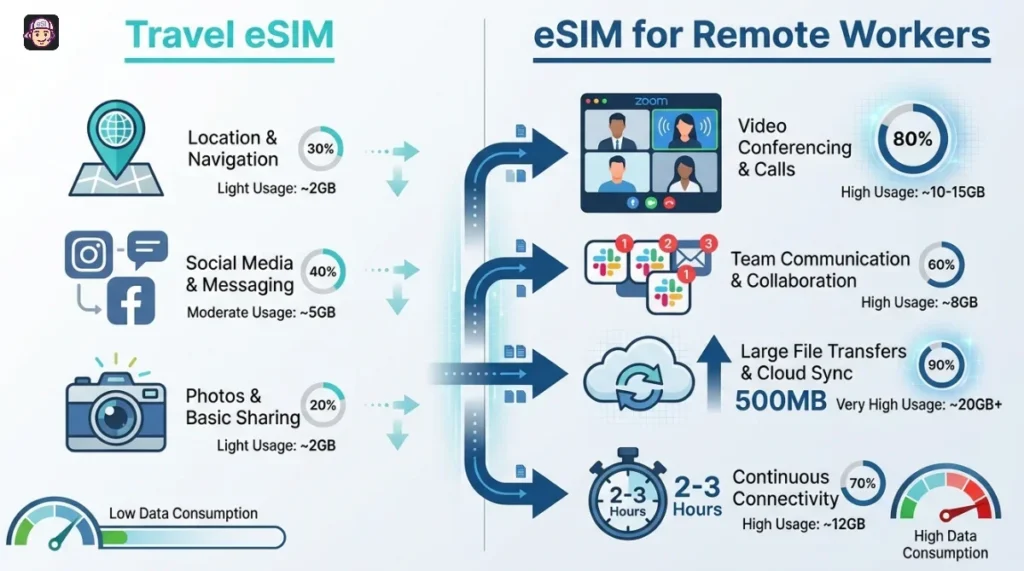
A regular travel eSIM handles maps and social media. An eSIM for remote workers needs to sustain a 2 to 3 hour Zoom session while Slack runs in the background and your cloud drive syncs 500MB of project files. That is a fundamentally different workload.
The setup runs like a portable office router. Your phone holds the eSIM as its data line while the physical SIM keeps your home number for two factor authentication and bank codes.
Enable the personal hotspot, connect your laptop via Wi-Fi, and you control your own network instead of sharing bandwidth with 40 other people in a coworking space. The connection is private by default, which matters for remote workers handling client contracts, financial data, or proprietary code.
Plan types rank differently for work use than for tourism. Unlimited or high cap regional plans with confirmed tethering win for eSIM for remote workers because a throttled connection mid-call is worse than no connection at all. Pay-per-GB plans work for light email days but fall apart during heavy upload sessions.
For eSIM for remote workers, high data regional plans with tethering enabled outperform cheap per-GB options because video calls and cloud syncs require sustained bandwidth over several hours. Prioritise providers that explicitly confirm hotspot speeds match plan speeds, not reduced tethering rates.
7 Best eSIM for Remote Workers 2026 Field Tested
| eSIM for Remote Workers | Work Advantage | Best Remote Profile |
|---|---|---|
| Airalo | Multi-country profile manager | Travelling consultants |
| MobiMatter | Lowest cost per work GB | Freelancers on tight margins |
| Maya | Deep regional office coverage | Long-stay remote employees |
| Amigo eSIM | Tethering on all plan tiers | Laptop-dependent workers |
| GigSky | Auto-switch at borders | Cross-border project managers |
| Saily | Encrypted work connection | Compliance-sensitive roles |
| Billion Connect | Dedicated hotspot device | Multi-device office setups |
1. Airalo
Airalo serves the eSIM for remote workers who operate across multiple client time zones and countries within a single quarter.
The Discover Global plan covers 190+ countries, and the app lets you pre-install separate profiles for each work destination before you fly. Top-ups happen mid-plan without reinstalling, which means your connection stays live even if you underestimate your weekly data use during a heavy sprint.
Plans start at $4.50 for 1GB, scaling to larger packages for extended project trips. For consultants and freelancers who bill by the hour and cannot afford connectivity gaps between countries, Airalo's profile management keeps work sessions unbroken.
Work-Ready Specs:
Why Airalo for Remote Workers: The multi-profile system is built for workers who change countries every few weeks. Instead of purchasing and installing a new eSIM at each destination, Airalo lets you queue profiles in advance and switch with a tap. That removes the single biggest productivity gap when relocating for work.
2. MobiMatter
MobiMatter aggregates plans from multiple carriers through a marketplace model, and that price competition directly benefits the eSIM for remote workers who track every expense against project revenue.
Coverage spans 200+ countries with app ratings above 4.7, confirming the onboarding works reliably despite the multi-carrier backend. The practical advantage for remote workers is cost visibility.
You see rates from several underlying providers for your destination and pick the best value before committing. For freelancers running lean or contractors not expensing connectivity, that transparency matters.
👉Get MobiMatter for Remote Work
Work-Ready Specs:
Why Mobimatter for Remote Workers: When you expense your own connectivity, every dollar matters. MobiMatter's aggregation model means you pay less per GB than almost any other provider on this list. The $50 ESIMDUDE code on top of already competitive rates makes this the cost leader for remote workers.
3. Maya
Maya fits the eSIM for remote workers taking a 30 to 90 day contract in a single region rather than hopping between continents.
The regional plan structure delivers stronger local carrier partnerships in Southeast Asia, the Middle East, and parts of Europe than global providers that spread thin.
For a developer spending two months in Bali or a content strategist based in Dubai for a quarter, Maya's regional depth translates to more consistent upload speeds and fewer dropped hotspot connections during working hours.
Work-Ready Specs:
4. Amigo eSIM
Amigo eSIM solves the most common frustration in the eSIM for remote workers space. Hotspot tethering works on every plan tier, including the $6 entry level options.
Many competitors restrict tethering to premium plans or throttle hotspot speeds to unusable levels. Amigo does neither. A remote worker running a budget project trip to Portugal can buy the cheapest available plan and still tether a laptop for a full work day. Coverage reaches 128 countries with 4G and 5G where available.
The money-back guarantee protects against activation failures, which is reassuring when your work depends on the connection.
👉Get Amigo eSIM for Remote Work
Work-Ready Specs:
Why Amigo for Remote Workers: The universal tethering policy is the reason Amigo belongs on a remote work list. Most providers gate hotspot access behind expensive plans. Amigo opens it on every tier, meaning even a $6 plan supports a full laptop tethering session. The 12% ESIMDUDE code brings that cost below $5.30.
5. GigSky
GigSky operates as a full MVNO rather than reselling other carriers' plans, and that technical structure gives it an edge for the eSIM for remote workers managing projects across European borders.
One eSIM profile handles automatic carrier switching when you drive from Berlin to Prague or fly from Madrid to Amsterdam. No manual APN changes. No reinstalling. The connection transfers silently.
A free 100MB trial lets you verify activation works on your device before committing work-critical data to the plan. The daily throttle threshold of roughly 2.5GB per day handles email, Slack, and one or two video calls but limits workers who run heavy uploads.
👉Get GigSky for Cross-Border Remote Work
Work-Ready Specs:
6. Saily
Saily adds something to the eSIM for remote workers space that no other provider on this list offers natively. Built by the NordVPN team, every plan includes ad blocking, malicious URL filtering, and IP masking.
For remote workers handling client NDAs, financial records, or proprietary assets over a mobile hotspot, that encryption layer matters. It also bypasses local content restrictions, which remote workers in certain Middle Eastern or Southeast Asian countries encounter regularly.
Coverage reaches 200+ countries, and the Ultra plan bundles unlimited data with 8% credit cashback for workers who travel monthly.
Work-Ready Specs:
Why Saily for Remote Workers: When you tether your laptop through a public-facing mobile connection, that data travels unencrypted by default. Saily's NordVPN layer encrypts the entire hotspot tunnel. For remote workers accessing client systems, corporate intranets, or banking platforms over a café hotspot, that is a practical security requirement, not a luxury feature.
7. Billion Connect

Billion Connect approaches the eSIM for remote workers problem by separating the hotspot device from the phone entirely.
Beyond standard eSIM plans, the company offers portable Wi-Fi units that create a dedicated network your laptop and tablet connect to without draining your phone battery. For remote workers running 6 to 8 hour work days on tethered connections, phone battery preservation is a real issue.
A separate pocket Wi-Fi device solves it while supporting 5 to 10 simultaneous connections for workers managing multiple screens.
Work-Ready Specs:
What Separates a Reliable eSIM for Remote Workers From a Tourist Plan
1. Sustained Bandwidth for Video Conferencing
A tourist eSIM handles Instagram uploads. An eSIM for remote workers must sustain 3 to 5 Mbps consistently for a 2 hour Zoom call with screen sharing. Providers like GigSky and Saily route through stronger carrier partnerships in major cities.
Instabridge tested at 40 to 60 Mbps download in Europe and North America but showed latency issues when traffic routed through distant servers. Always test with the free trial or refund period before relying on any provider for live client work.
2. Tethering Policies That Support Laptop Work
Many eSIM providers quietly restrict tethering speeds or block hotspot use on cheaper plans. For remote workers, tethering is the entire point.
Amigo eSIM confirms hotspot on all tiers. Airalo supports it on most global plans. Confirm tethering is explicitly allowed, not just technically possible, before purchasing any plan for work use.
3. Data Volumes That Match Actual Work Days
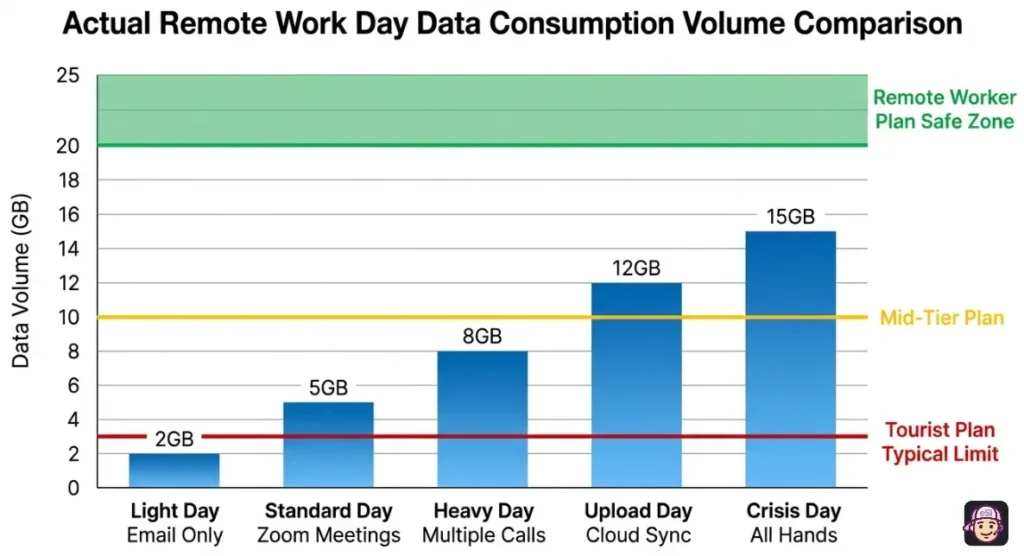
One remote work day with Slack, email, cloud syncs, and two video calls consumes 4 to 6GB. A five day work week abroad needs 20 to 30GB minimum.
Plans under 10GB will run out mid-week. For sustained work travel, look at Saily's unlimited Ultra plan or Mobimatter's marketplace rates on high-cap regional plans.
4. Security on Public and Shared Networks
Tethering through a mobile connection is more secure than café Wi-Fi, but the data still travels through a carrier's infrastructure. Saily's NordVPN encryption adds a genuine security layer.
For workers without Saily, running a separate VPN on the laptop over the eSIM hotspot achieves similar protection. Prioritise encrypted connections when accessing client portals, financial tools, or code repositories.
5. Cost Predictability for Monthly Budgets
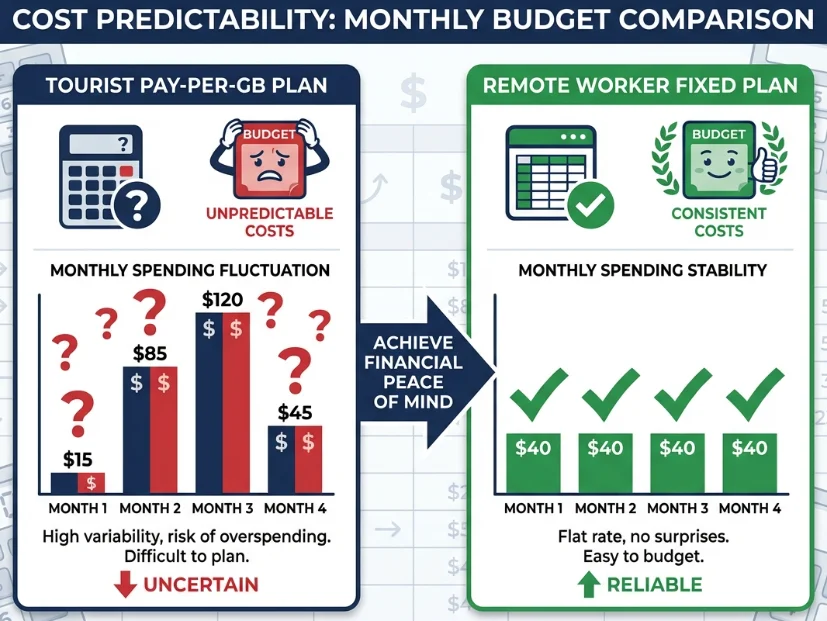
Remote workers need to budget connectivity monthly. Per-GB plans create variable costs. Flat-rate regional or unlimited plans create fixed costs.
For consistent work travellers, Saily's Ultra or Gigsky's monthly tiers offer predictable billing. For variable travel schedules, Airalo's per-trip purchasing avoids subscription waste.
Answers to Real Questions About eSIM for Remote Workers
Can I run Zoom calls reliably through an eSIM hotspot?
Yes. A stable eSIM hotspot delivering 3 to 5 Mbps handles Zoom, Google Meet, and Teams with screen sharing. Providers like Saily and Airalo deliver these speeds in major cities across Europe, Southeast Asia, and the Americas. Test during the refund window before critical client calls.
Which eSIM for remote workers offers the strongest encryption?
Saily includes built-in ad blocking, URL filtering, and IP masking through its NordVPN technology. No other provider on this list bundles native encryption. For workers using other eSIM providers, a standalone VPN app on the laptop achieves comparable protection over the tethered connection.
How much data does a remote work day actually consume?
A typical remote work day with email, Slack, cloud storage syncs, and two video meetings uses 4 to 6GB. A full work week needs 20 to 30GB. Choose plans with at least 20GB or unlimited data to avoid mid-week outages during critical work periods.
Can my employer block or detect eSIM tethering?
Employers cannot block your eSIM tethering. Some corporate VPNs may flag connections from foreign IP addresses. Using a VPN that routes through your home country resolves this. Saily's built-in IP masking handles it natively. Other providers require a separate VPN.
Is there a free eSIM that works for remote work?
Gigsky offers a free 100MB trial, useful for testing activation but not for actual work. No provider offers free data volumes sufficient for a remote work day. The most risk-free option is Saily's 30 day money-back guarantee, which lets you test a full plan and refund if it falls short.

Final Thoughts
Airalo gives travelling consultants the cleanest multi-country profile management for hopping between client sites.
Saily adds the security layer that compliance-sensitive remote roles genuinely require. And Amigo eSIM remains the most practical budget pick because tethering works on every plan, even the $6 ones. Test any provider through a refund period or free trial before your first live client meeting abroad.
The right eSIM for remote workers turns your phone into a portable office router. The wrong one drops your client call at the worst possible moment. Spend the 10 minutes to test before you trust it with work.
How we test eSIMs
iPhone 15 Pro Max
iPhone 17 Pro Max
Samsung Galaxy S25 ultra
iPad Pro M4
32+ eSIM Providers Tested
150+ Speed Tests Verified
10+ Countries Covered
Why You Can Trust eSIMNinja
We buy every eSIM plan with our own money — no freebies, no sponsored reviews. What you read is what we genuinely experienced.
We keep receipts. Every eSIM is personally purchased.